
This Tiny Island Has Everything (Caye Caulker, Belize)

Updated: Aug 26

There are places that announce themselves loudly, with resorts stacked like glass and steel and brochures promising perfection. Caye Caulker does none of that. It sits in the Caribbean like it has always been there and always will be, unconcerned with attention.
The first thing you notice is not a landmark. It is the absence of urgency.
No one is rushing. Boats idle instead of roar. Conversations stretch out across wooden docks. Even the wind feels like it has decided to take its time.
This is the island’s philosophy: Go Slow. It is painted on signs, spoken casually, and lived completely. Not as branding, but as breathing.
And somewhere in that slowing down, the island starts to reveal what it actually is.
Arrival: The Water Changes First

Getting to Caye Caulker already feels like a transition out of ordinary geography.
The ferry cuts through water that keeps changing its mind about color. One moment pale green glass, the next deep Caribbean blue, then suddenly so clear you can see shadows moving beneath the surface.
The island appears low on the horizon, almost reluctant to rise too high. No skyline. No spectacle. Just a thin strip of sand and palms that seems to have drifted into place.
When you step off the boat, the ground is warm and uneven. Sand replaces pavement almost immediately. The sound of wheels fades because there are barely any cars. Only golf carts and bicycles moving like they understand the assignment: nothing urgent.
You don’t arrive here so much as you decelerate into it.
The Island That Refuses to Hurry
Caye Caulker is small enough that you begin to trust your own footsteps instead of maps. No cars drive down the unpaved sand streets.
Automobiles are not allowed. It's all golf carts from the rich expats and bicycles for the well to do locals. Everybody else walks.
There is no real “center” in the way cities have centers. Instead, there are pockets of life:
a dock where someone is always sitting
a shack with music drifting out like smoke
a stretch of sand where the ocean comes close enough to erase your sense of edges
People talk easily. Strangers become temporary neighbors. And time behaves strangely, as if it has loosened its belt. If you see Mandingo on the main strip buy him a beer but negotiate on his hats he makes to sell to tourists...

You start noticing how little you need to feel full of a place.
The Reef: A Second World Just Offshore
If the island is calm, the water around it is something else entirely.
Just beyond shore, the Caribbean shifts into layered blues that feel almost constructed. But it isn’t artificial. It is alive in the way things are alive when they’ve been left alone long enough to become themselves again.
Snorkeling or scuba diving here is not a checklist activity. It is a slow descent into something older than you.
Coral structures rise from the seabed like quiet cities. Fish move through them without hurry, without awareness of being observed. Parrotfish scrape at coral with the sound of distant rain. Sergeant majors flicker like punctuation marks in blue sentences you are trying to read.
The reef doesn’t perform. It persists.
And in that persistence, it becomes impossible not to feel small in a very specific, grounding way.

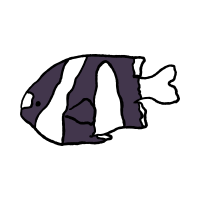
Beautiful Gray Angelfish
There was one reason I came to Belize in the first place.
The Blue Hole.
I'd been diving for about 20 years when i decided to go to belize for the blue hole, and I wanted to see it for myself.
I dove with a company that was one of only a few operators in Caye Caulker running trips to the Blue Hole. The trip wasn't cheap, and getting there took about two hours by boat. But I happened to be there during the low season, and they discounted the trip to get enough divers together to make it happen.
Capitalism at work.
The discount worked.
They got their divers, and we headed out.
The Blue Hole trip takes time. It costs more than a local reef dive. And because of that, fewer divers make the trip. The trip was in 3-4 foot seas. It beat the shit out of all of us on the boat. Because the boat ride was so long, the dive shop turned it into a 3 dive trip. the first was the blue hole, then after the appropriate surface intervals came the lighthouse reef, and then the aquarium. After the lighthouse reef we stopped at Half Moon Caye for lunch. Unbelievable.
That turned out to be a very good thing.
The reefs on the final dives were spectacular. They felt untouched. The coral was healthy, the fish were everywhere, and the water seemed to go on forever.
Then came the reef sharks.
I saw more reef sharks on those last two dives than I had probably seen in the previous fifteen years of diving combined.
Those were two of the best dives I had ever done.
Twenty years underwater, and Belize still managed to surprise me.
That's saying something.
Hunting Lionfish and Eating the Catch
Caye Caulker gave me another first underwater.
I went lionfish hunting with Scuba Sensations, one of the few dive shops I found on the island offering this type of dive. Bert took me out with a friend, and we went looking for lionfish.
I almost had one right off the bat.
Almost.
It got away.
Bert wasn't as unlucky. He found a couple, and we ended up making fresh lionfish ceviche right there on the boat.
It was delicious.
He also caught one for me to take back to shore. I brought it to Chef Kareem's, and that lionfish became dinner.
That's one of those dive memories that sticks with you.
You see the fish underwater.
You catch it.
You eat it.
The entire trip from reef to plate can happen in a single afternoon.
Food on the Island: Simple, Direct, Honest
Food in Caye Caulker does not try to be clever. It doesn’t need to.
It arrives from the sea or the fire or a small kitchen where someone knows exactly what they are doing without needing to explain it.
From the places I ate during my time on Caye Caulker, a pattern emerges: the best meals here are not about presentation. They are about proximity.
Seafood tastes like it came from nearby water because it did. Lobster,

when in season, is grilled with a kind of confidence that doesn’t require garnish. Conch is prepared with lime, heat, and timing that feels inherited rather than learned.
One day the island gave something more personal.
A line in the water

. A pull. Then a snapper, silver and alive in the hands, still carrying the ocean in its movement. It is strange how quickly a moment becomes food here, how the distance between catching and eating collapses without ceremony.
That fish was brought ashore and handed over like a simple fact of the day. Chef Kareem’s UnBelizeable Lunch did not make a show of it. There was no need. The grill was already hot, already waiting. The snapper met the fire and changed form without resistance. Smoke rose, salt tightened, and soon it was on a plate eaten standing up near the street where everything important seemed to pass through anyway.
Chef Kareem's Unbelizable Lunch Caye Caulker Chef Kareem's Unbelizable Lunch Caye Caulker 
Chef Kareem's Unbelizable Lunch Caye Caulker
Another day, the sea offered something different.
Lionfish, taken carefully from the reef where it does not belong, removed not with celebration but with purpose. Speared on a dive that felt quiet and deliberate. Brought back to the boat where the ocean still moved beneath us.
On deck, the transformation began again. Simple knives. Citrus. Hands working without rush. Fresh ceviche forming while the boat rocked slightly, the horizon holding steady like it had seen this before.
The first bite tasted like salt and lime and the effort of being present in a place that does not waste motion. Nothing ornamental. Nothing left over.

lionfish hunt dive at Scuba Sensations 
lionfish caught on dive 
lionfish getting ready for dinner 
lionfish ceviche fresh out of the Water
You don’t remember menus. You remember moments:
standing near open air kitchens as smoke drifts sideways
eating fish that was in the water earlier that same hour
cold drinks sweating onto wooden tables
plates arriving without ceremony but disappearing quickly
The food matches the island: unpretentious, steady, and quietly excellent.
Nothing demands praise. It simply holds its place.
Lobster Season: When Dinner Gets Really Good

I happened to be in Belize during lobster season. That was very good news for me.
Lobster season in Belize runs from July 1 through the end of February. From March 1 through June 30, Caribbean spiny lobster is off the menu. Catching, selling, and serving it are closed during that period to protect the breeding population.
I didn't waste my opportunity.
I crushed lobster for dinner almost every night.
And the best part? It was cheap. Really cheap. Coming from Texas, I was used to Atlantic lobster being something you ordered when you wanted to spend a little money. In Caye Caulker, it was suddenly part of the regular dinner rotation.
That is one of the pleasures of traveling. Sometimes you find yourself eating something you would normally consider a special occasion meal, and suddenly it is Tuesday night dinner.
Conch follows a different season. In Belize, conch season generally runs from October 1 through June 30. It can close earlier if the national catch quota is reached.
The seasons matter. They protect the animals and give the fishery a chance to continue. And when you visit during an open season, you get to experience an important part of the local food culture while it is happening.
One of the best food experiences I had in Caye Caulker wasn't ordering something from a menu.
It was catching dinner.
I took fresh barracuda and yellowtail snapper to Chef Kareem's UnBelizeable Lunch on Front Street. Chef Kareem will take the catch of the day and turn it into a proper Belizean meal, complete with a huge plate of rice, beans, and the rest of the good stuff.
This is the kind of meal I look for when I travel.
It isn't complicated. You caught the fish. You brought it to the chef. He cooked it.
That's it.
Fresh fish. Hot food. No fuss.
I had reviewed Chef Kareem's before, and my experience was exactly what I hoped it would be. The food was excellent, the portions were generous, and the whole experience felt like street food Belize style.
It also gave me a chance to do something I couldn't do at home quite as easily.
Catch my dinner in the Caribbean and hand it to a local chef.
I'll take that over a restaurant menu any day.
Dinner wasn't the only meal I took seriously.
I discovered Errolyn's House of Fry Jacks on Middle Street simply by walking past it.
Then I smelled the fry jacks.
That was the end of that.
Fry jacks are a Belizean breakfast specialty. Think of the general idea of a breakfast taco, but wrapped in fried dough instead of a tortilla.
And they were absolutely delicious.
Once I found Errolyn's, I went back almost every morning.
I crushed them.
There really isn't a better word for it.
Sometimes the best restaurants on a trip aren't the ones you researched beforehand. You just walk past a doorway, smell something amazing, and follow your nose.
Hidden Corners and Small Discoveries
Caye Caulker doesn’t hide secrets. It just refuses to highlight them.
A narrow path between buildings might lead to an empty stretch of sand where the water laps without interruption. A dock at the wrong hour becomes completely private.
A small bar you almost walk past becomes the place you stay longer than planned.
Nothing is staged. Everything is discovered.
Even wandering feels like participation rather than exploration. You are not unlocking the island. You are simply moving through it at the speed it allows.
Sunset: The Daily Closing of Everything

Evenings on Caye Caulker arrive without announcement.
The light begins to shift first, as if the sky is adjusting its focus. Blues deepen. Gold appears in thin bands along the horizon. Then orange spreads slowly, not as explosion but as surrender.
People stop moving in ways they don’t notice. Conversations thin out. Boats rest without noise.
The sunset is not an event here. It is a shared pause that no one organizes but everyone respects.
And when it finally fades, there is a brief moment where the island feels completely still, like it is remembering itself before night arrives.
Practical Notes for Traveling Here
Caye Caulker is not complicated, but it rewards awareness.
Getting there: Ferry access from Belize City is the most common route. The ride itself is part of the transition.
Getting around: Walking, biking, or golf carts. You adjust quickly.
Best rhythm: Early mornings are quiet and clear. Late afternoons belong to water and light.
Snorkeling: Reef trips are essential. Visibility is often excellent, and marine life is abundant without being forced into spectacle.
Food: Follow local recommendations more than online rankings. The best meals often don’t advertise themselves loudly.
Costs vary, but the island’s value is not in luxury. It is in simplicity that doesn’t feel like deprivation.
Is the Blue Hole Worth the Trip?
If you're considering a Blue Hole dive from Caye Caulker, understand what you're getting into.
It is a long day. The boat ride takes roughly two hours each way, and the trip costs more than a normal local reef dive.
But if you're an experienced diver and the Blue Hole is on your bucket list, I think it is worth considering.
For me, there was no question. It is still the deepest dive I have been on in almost 30 years of diving!
The Blue Hole was the reason I came to Belize.
And after spending the day underwater, I understood why people make the trip.
Why It Stays With You
Caye Caulker doesn’t overwhelm memory. It settles into it.
You don’t leave with a list of attractions completed. You leave with a feeling that something unnecessary was removed from your thinking for a while.
The reef, the food, the water, the slow movement of everything—it all blends into a single impression:
Life can be less compressed than you think.
And once you’ve seen that, even briefly, it doesn’t fully disappear.
The island is small.
But it lingers like something much larger. More of my Travel Experiences Here!
Caye Caulker was the best!!