

🌊 Scuba Diving Phi Phi Island, Thailand: A Journey Beneath Paradise

Updated: 3 days ago

There are places that look stunning from above. Then there are places that truly come alive below the surface.
The Phi Phi Islands are both.
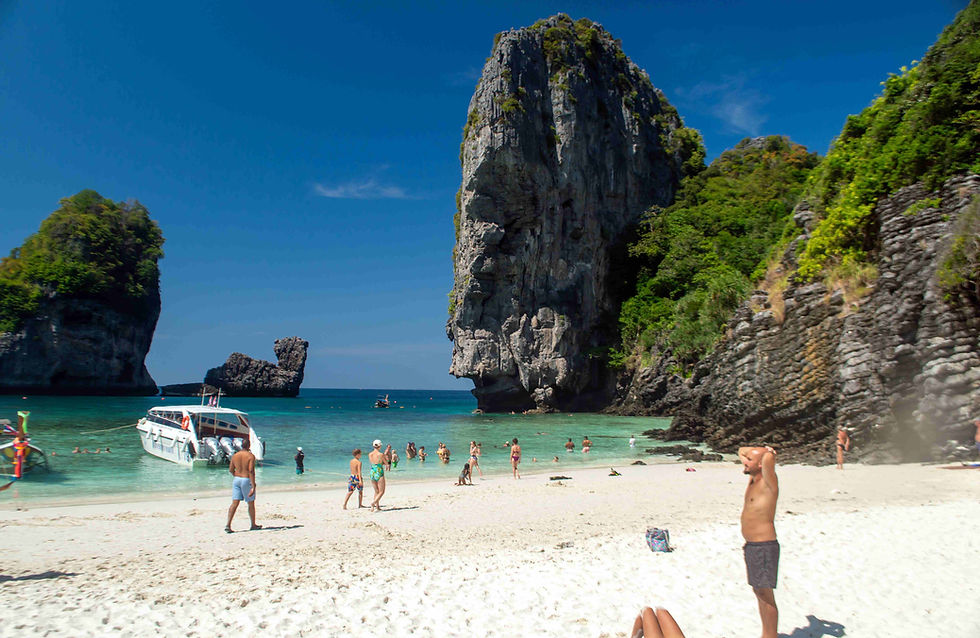
Located in the Andaman Sea between Phuket and Krabi, Phi Phi is famous for towering limestone cliffs, turquoise water, white sand beaches, and tropical scenery that almost looks too perfect to be real.
But for me, the real attraction was underwater.
I came to Phi Phi Island to scuba dive and explore the marine life beneath the surface. I brought my GoPro Hero 8 to capture the experience in 4K, hoping to bring some of that underwater world back home.
What I found was a place filled with color and movement.
Schools of fish moved across the reef. Coral formations covered the rocks. Sunlight filtered down through the blue water. Every few seconds, something caught my attention.
And sometimes it was something small.
A Moorish idol.
A parrotfish.
A bannerfish moving through the reef.
These are the moments that make scuba diving so addictive.
Getting to Phi Phi Island
Getting to Phi Phi Island was actually easy enough.
I booked my transfer tickets online through phuketferry.com.
The website was simple to use and made it easy to arrange the entire trip before I even left Phuket.
I booked transportation from Phuket Airport to the ferry, the ferry to Phi Phi, and then the return trip from Rassada Pier in Phuket with a transfer back to Patong.
Everything was arranged online.
And it worked.
Each time I needed a transfer, the drivers were there waiting for me. There was no standing around wondering where I was supposed to go next.
The ferry crews also helped with the baggage, which made the process even easier.
I chose the Satun Pakbara Speed Boat Club for the ferry portion of the trip. When I booked, the website was offering about a 20% discount on the one-hour trips, so I decided to go with them.
The trip usually takes around 45 minutes to an hour, depending on the sea conditions and weather.
That part is worth remembering.
The Andaman Sea can change its personality pretty quickly.
But when the weather cooperates, the ride is a great introduction to the islands. Phuket slowly disappears behind you and the limestone cliffs of Phi Phi begin to rise from the horizon.
It feels like you're heading somewhere special.
Arriving at the Main Pier
When you arrive at Phi Phi, you come into the main pier.
This is where the ferries from Phuket drop passengers off. From there, the longboats take guests to their hotels around the island.
The entire area around the pier has a great vibe.
There is movement everywhere. Longboats coming and going. Travelers carrying bags. People heading toward hotels, restaurants, beaches, and dive shops.
It feels busy without feeling like a major city.
And the longboats are part of the experience.
They are not simply transportation. They are one of those little pieces of island life that make arriving in Phi Phi feel different from arriving at a typical resort destination.
Staying at Phi Phi Bayview & Premier Resort
I stayed at Phi Phi Bayview & Premier Resort over Christmas.
Ao Ton Sai Bay
The resort is right on the beach and stretches up the hillside. That means some of the rooms are quite a hike up the hill.
Fortunately, the hotel offers a free golf cart service to take guests back and forth to their rooms.
That was definitely appreciated.
My room was nice and spacious, and it was clean. The location was also convenient because it was only about a 12 to 14-minute walk into town.
The walk itself was part of the fun.
You can walk along the beach toward town and take in the scenery along the way. There are restaurants, shops, bars, and plenty of activity once you get closer to the main village.
The resort also did something nice for Christmas.
They gave guests gift cakes on Christmas Day.
It was a small gesture, but a nice touch.
There was another detail about arriving at the resort that I learned the hard way.
The hotel has a longboat that picks guests up from the pier. When you arrive, the boat takes you toward the beach and then you get out into the water to reach the check-in area.
Wear shorts.
And wear flip-flops.
I was wearing jeans.
Yes, I got wet.
Sometimes travel gives you memories that were not included in the itinerary.
Exploring Phi Phi Above and Below the Water
Phi Phi Island has plenty to see above the water, but I was there to explore what was underneath it.
The surrounding waters are part of the larger Andaman Sea ecosystem, which is known for tropical coral reefs and an impressive variety of marine life.
I filmed my dives with a GoPro Hero 8 in 4K.
A GoPro is a great little camera for scuba diving because it allows you to get close to the action without carrying a large camera setup underwater.
It also captures the wide-angle perspective that makes underwater scenes feel immersive.
The challenge is that underwater footage depends heavily on visibility, depth, sunlight, and water color.
You can have an amazing reef right in front of you and still have the footage look completely different from what you saw with your own eyes.
That is part of the fun of underwater photography.
You never quite know what the camera is going to bring home.
One of the highlights of my Phi Phi Island diving experience was exploring Bida Nok Reef.
Koh Bida Nok is a small limestone island south of the main Phi Phi islands, and the surrounding reef is a popular scuba diving destination. Once I was underwater, the scenery changed completely. The limestone cliffs and tropical beaches disappeared above me, replaced by coral, rock formations, and schools of reef fish moving through the blue.
I filmed the dive with my GoPro Hero 8 in 4K, trying to capture as much of the reef and marine life as possible. The water was warm, and there was plenty to see as we moved along the reef.
This was also where I encountered some of the marine life featured later in this post, including a Moorish idol and parrotfish feeding along the reef.
What I enjoy most about dives like this is that you never know what will appear around the next coral formation. One minute you're following the reef, and the next something catches your eye and sends you swimming in a completely different direction.
Bida Nok was a great reminder of why I enjoy scuba diving in Thailand. The scenery above the water is spectacular, but beneath the surface there is another world waiting to be explored.
The Moorish Idol

One of the fish I encountered during the dive was the Moorish idol, scientifically known as Zanclus cornutus.
The Moorish idol is one of those fish that is almost impossible to mistake for anything else.
It has bold black, white, and yellow markings and a long, trailing dorsal filament that gives it an elegant appearance.
It almost looks like the fish is wearing a flag.
Moorish idols are commonly associated with coral reefs in tropical and subtropical waters across the Indo-Pacific. They spend much of their time picking at food from the reef and surrounding surfaces.
They can also be surprisingly difficult to photograph.
The long dorsal filament seems to move constantly, and the fish never appears to be in quite the same place for long.
That is part of what makes seeing one while diving so enjoyable.
You spot it.
You start following it.
You try to get the camera lined up.
And then it swims away.
The reef always seems to have the last word.
The Chlorurus sordidus Parrotfish

Another interesting fish from the dive was the Chlorurus sordidus parrotfish.
Parrotfish are some of the most important residents of a healthy coral reef.
They have specialized teeth that are fused together into a beak-like structure. They use them to scrape algae and other material from the reef surface.
That behavior is important because it helps keep algae from taking over coral habitats.
And there is another fascinating part of the story.
When parrotfish scrape and bite at the reef, they can also ingest pieces of coral rock. Their digestive systems process the material, and the resulting sediment contributes to the fine sand found around many tropical islands.
In other words, some of the beautiful tropical beaches around the world have a little help from parrotfish.
That makes watching one feeding on the reef a lot more interesting.
What looks like a fish simply munching on coral is actually part of a much larger reef ecosystem.
Heniochus singularius

the singular bannerfish, a butterflyfish 
the singular bannerfish, a butterflyfish
I also encountered Heniochus singularius, commonly known as the singular bannerfish.
At first glance, it is easy to understand why these fish catch your eye.
They have a striking black, white, and yellow pattern, along with a long dorsal filament that trails behind them.
They are members of the butterflyfish family and are associated with coral reef environments throughout parts of the Indo-Pacific.
Their contrasting colors make them stand out against the blue water and darker reef.
That is exactly the kind of fish that looks fantastic on underwater video.
You can be swimming along without much happening, and suddenly a bannerfish moves across the frame.
The colors pop.
The fish disappears around a coral formation.
And you keep swimming, wondering what will appear next.
That is one of my favorite things about scuba diving.
You never really know what the reef is going to show you.
A Different World Beneath the Andaman Sea
Once you descend beneath the surface, everything changes.
The sounds of the island disappear.
You hear your breathing.
You hear the bubbles rising toward the surface.
Then you start noticing the smaller details.
A fish hiding inside the reef.
Movement in the coral.
Light shifting across the bottom.
A school of fish suddenly changing direction.
The underwater world has its own rhythm.
Phi Phi is often described as a tropical paradise, and that description makes sense when you're standing on the beach.
But underwater, it becomes something completely different.
The cliffs and beaches disappear.
The reef becomes the landscape.
Loh Dalum Bay
One of the places I spent time exploring above the water was Loh Dalum Bay.
Loh Dalum Bay is a shallow, sheltered crescent-shaped bay on Ko Phi Phi Don in Krabi Province. It sits right beside the main Ton Sai village area.
The water is clear and turquoise, and the soft sandy beach makes it a popular place for swimming and relaxing during the day.
But the personality of the bay changes after dark.
The shoreline becomes lively with beach bars, music, and evening fire shows.
It is a completely different atmosphere from the quiet underwater world I experienced during the day.
There is also a memorial on the beach dedicated to those who lost their lives in the 2004 tsunami.
That is an important part of Phi Phi's history.
The islands have experienced tremendous tourism growth, but they also carry memories of a devastating event that changed the community forever.
Another Phi Phi Sunset Is Coming

Of course, I couldn't spend time on Phi Phi Island without looking for a sunset.
One of the sunsets I captured was over Loh Dalum Bay.
The bay becomes a beautiful foreground for the evening light. The water reflects the changing sky while the silhouettes of the surrounding islands begin to darken.
It is a completely different experience from scuba diving.
Underwater, everything is blue.
At sunset, everything becomes gold.
I captured another sunset video here, and I'll be sharing more of that experience soon.
So if you enjoy tropical sunsets as much as I do, there is more Phi Phi Island coming.
Why Scuba Diving at Phi Phi Stays With You
There are plenty of beautiful places in Thailand.
Phi Phi is different because so much of the experience happens in one small area.
You can arrive by speedboat.
Walk along the beach.
Explore the village.
Eat dinner near the water.
Watch the sunset.
Then wake up the next morning and go scuba diving in the Andaman Sea.
That combination makes the islands hard to forget.
For me, the diving was the highlight.
The GoPro Hero 8 captured the reef, the fish, and the blue water in 4K. But even the best camera cannot completely capture what it feels like to hover over a reef with nothing around you except water and marine life.
That part belongs to the experience.
Final Thoughts
My trip to Phi Phi Island was easy enough to arrange from start to finish.
The ferry transfers were simple to book. The drivers were waiting. The crews helped with the bags. The resort was comfortable and close enough to town to make exploring easy.
And then there was the diving.
That is where Phi Phi really came alive for me.
A Moorish idol moving through the reef.
A parrotfish scraping algae from the coral.
A bannerfish drifting through the blue.
Schools of tropical fish moving in every direction.
Sunlight filtering through the water.
And the steady sound of breathing through a regulator.
Those are the moments that stay with you.
Phi Phi Island may be famous for its beaches and towering limestone cliffs.
But beneath the surface is another world entirely.
And that is the world I came to see.
If you haven't watched the scuba diving video yet, take a few minutes and dive beneath the surface with me.
Put on your headphones.
Turn up the volume.
And let the Andaman Sea do the rest.
Comments